Vy Tsan
12 November 2025
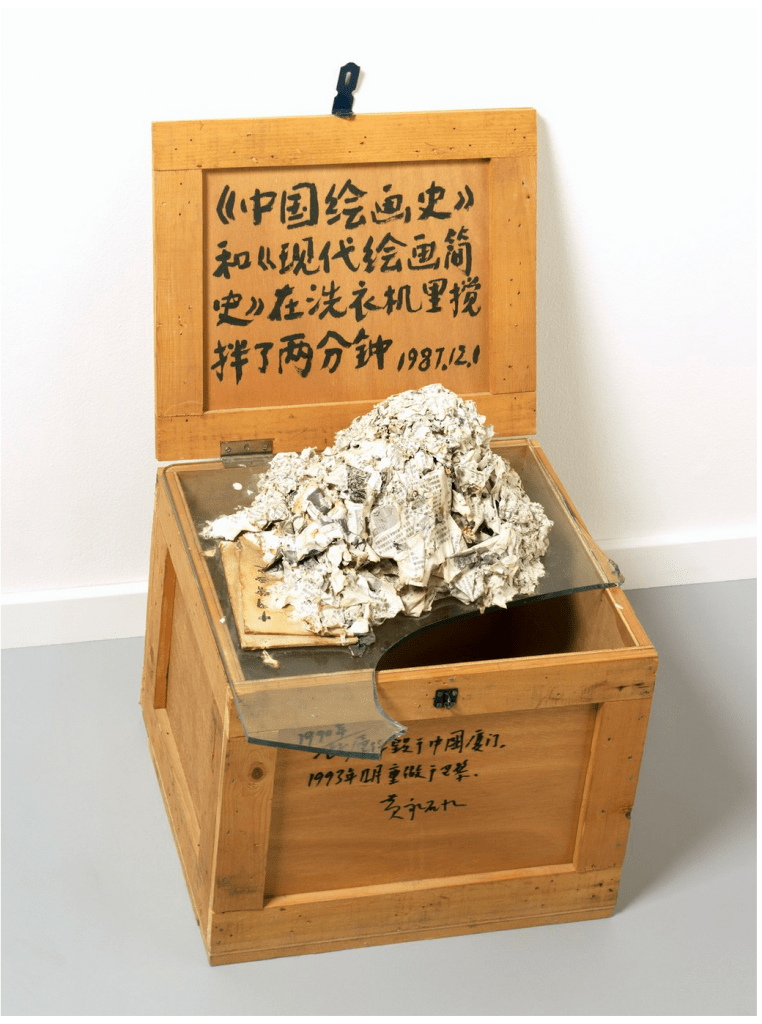
of Modern Western Art Washed in the Washing Machine
for Two Minutes (1987/1993), Chinese taboo, paper pulp, glass, Walker Art Center.
In 1988, Derrida wrote that: “The text is not the book, it is not confined in a volume to the library. It does not suspend reference – to history, to the world, to reality, to being, and especially not to the other”. (1) That is to say, language (text-image-sound) and the realities it seeks to represent cannot be confined within books nor other closed systems of meaning. Instead, the text remains open and entangled within an unstable system of signs which defer and refer beyond themselves. Whilst Derrida was writing deconstruction and différance into the world, contemporary Chinese artist Huang Yong Ping (1954—2019) was staging an enactment of it.
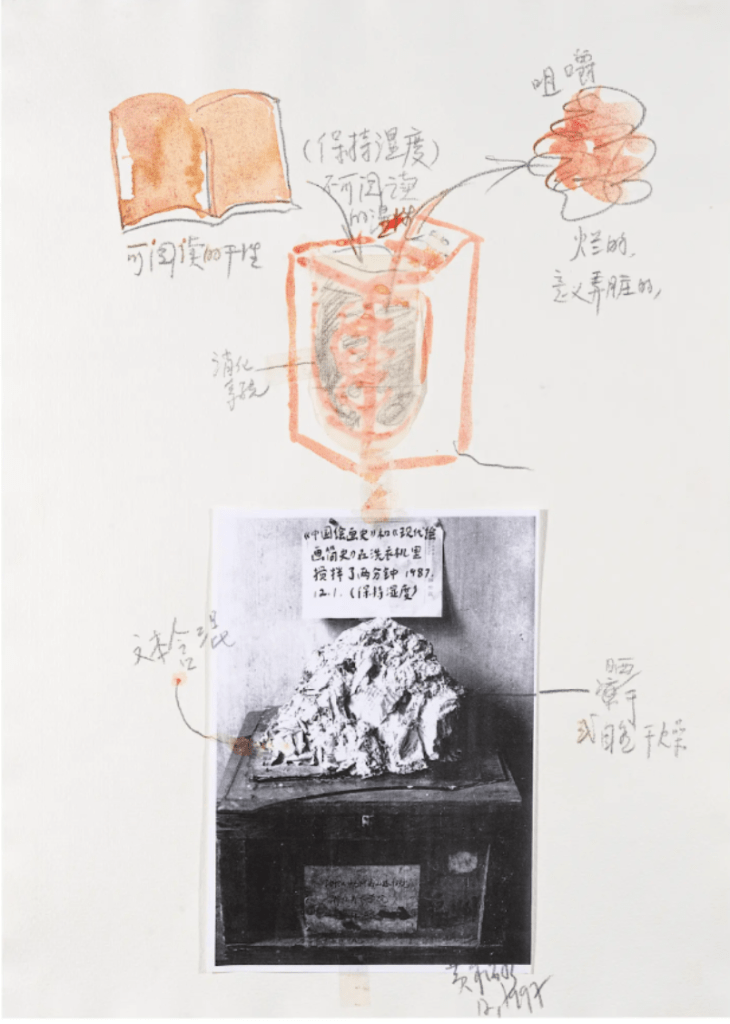
On the first of December in 1987, Huang took two books of art history, Wang Bomin’s The History of Chinese Painting (1982) and Herbert Read’s A Concise History of Modern Painting (1959), and put them into a washing machine on a two-minute cycle. The resulting mass of paper pulp would then be presented on a sheet of broken glass atop a wooden box, as The History of Chinese Painting and the History of Modern Western Art Washed in the Washing Machine for Two Minutes (1987) (hereafter “Two Minutes”). First shown at the 1989 China/Avant-Garde exhibition in Beijing, after the death of Mao Ze Dong and the fall of the Gang of Four, the dialectical logics of Chan and Dada converged within Two Minutes.
The icon of Dada is undoubtedly Duchamp’s response to the modern question of What is Art?: “an upside down urinal”.(2) In his essay Xiamen Dada—Postmodern? (1986), Huang draws upon the wisdom of the Taoist masters to discuss Fountain (1917). Duchamp’s urinal embodies Zhuangzi’s idea of the ubiquity of the Tao (‘way’) which is found “in an ant, in weeds, in a potsherd, and in urine.”(3) Through this, “Duchamp comes closer to Laozi’s concept of “hiding one’s brilliance, appearing dull” … than any modern Asian [person]”.(4) For Huang, Dada as the answer to Art also reflects the same sentiments as: “a dried feces stick” (Master Yunmen) or “three pounds of flex” (Master Dongshan) as the answer to “What is Buddha?”.(5) These monks and philosophers are not only suggesting that the divine is present in all things, but also critiquing language, implying that it is absurd to attempt to define the divine.
In Two Minutes, Huang draws upon this logic to answer to the question of “What is Chinese Art?” and perhaps in doing so also touches upon the parallel question of “What is Western Art?”. In placing two culturally authoritative attempts at answering these questions in a washing machine, the books by Wang and Read, Huang destroys their textual legibility but finds what he calls a new, “readable dryness” in the pulp.(5) This washing of words reflects Wittgenstein’s view of language wherein “some wordings should be removed from language and be sent to be washed—and after that they can be brought back into communication”.(6) However, Huang’s words cannot be brought back as the books cannot be unwashed. The mutual exposure between Chinese ‘artistic traditions’ and Western ‘art’ in the late-twentieth century had already destabilised both of these systems.
During the post-Mao period, it was not only foreign image and thought like Dadaism that entered the new vernacular of Chinese artists, but also traditional knowledge including Chan Buddhism, which was previously suppressed as one of the “four olds”.(7) This intellectual climate and the resurgence of traditional culture allowed Huang to re-encounter Chan Buddhism, in a theoretical sense:
“In China, the only way to access books is if it gets republished and becomes available in bookstores … Surely I knew of Chan Buddhism, but to come across a book academically professional as An Anthology of the Five Transmissions of the Lamp was only possible when it was republished.” (8)
From the anthology, Huang draws out a koan (paradoxical anecdote, riddle of sorts or simply a “case”) where the Buddha is holding a sermon on the peak of Vulture Mountain with an assembly of monks. Instead instead of speaking at the sermon, he picks up a flower and shows it to his students.(9) In response to this lesson, the monks remain silent in bemusement except Mahakasyapa who smiles at the Buddha, to which the master responds:
“I have the eye of the true law, the secret essence of Nirvana, the formless form and the ineffable Dharma which is not dependent on speech or words … All this, I pass to Mahakasyapa.”(10)
Huang discusses this koan in his essay Completely Empty Signifiers: ‘Dada’ and ‘Chan Buddhism,’ written between the two-minute cycle and its exhibition in Beijing, interpreting it as a conversation made up of ‘empty signifiers.’(11) Here, Huang conforms to Barthes’ semiological system where first order of the Sign is comprised of its physical form, the Signifier (text-image-sound) and the Signified content (or concept).(12) However, there also exists a second-order sign which encompasses myth, which takes an entire sign and turns it into a further signifier for broader, often ideological meaning.
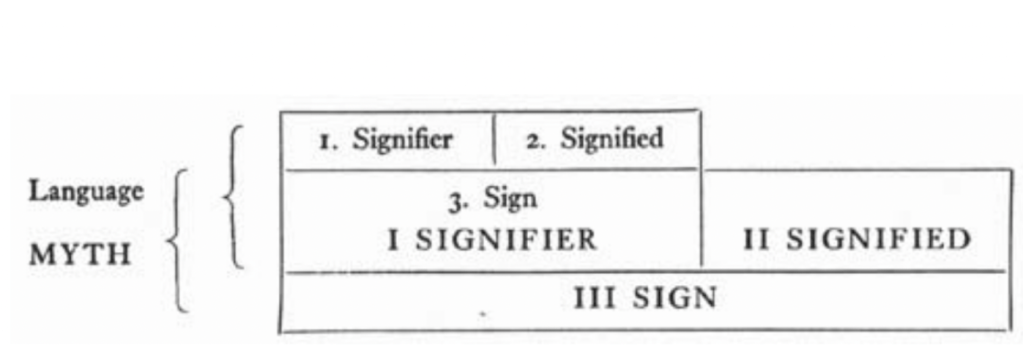
Within Two Minutes, the Wang and Read books respectively represent, the traditions of Chinese ink painting and modern Western art, and in their pre-washed form, embody the transfer of knowledge in 1980s China through text. Then as a mass of paper pulp, they act as a primary sign for the destruction of knowledge, as these books were published as authoritative and institutionally sanctioned narratives of Chinese and Western art. Huang then extends the myth through presenting this entire first-order sign as a cultural signifier representing the collapse of the East/West—Tradition/Modernity binaries within not only art history, but broader cultural discourse.
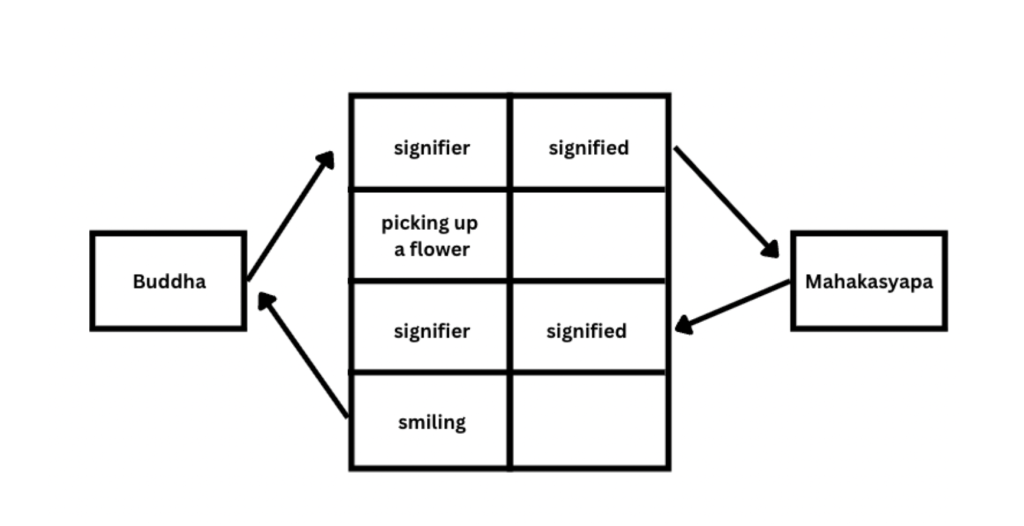
The mass of pulp within Two Minutes is an empty signifier, one without substantial meaning, and the semiotic site where Dada and Chan Buddhism converge. The Buddha picking up a flower has no specific meaning. However, it begs to interpreted as a sign due to the modern linguistic habit which presupposes that every gesture corresponds to meaning, and that the Buddha himself is such a mythologised sign that any mere gesture that he makes must be profound. Thus, Mahakasyapa is wise to respond to an empty signifier with another. Huang appropriates this koan to also describe Dada, which is neither “rocking-horse” nor “yes, yes” but a symbol of “destruction, nihilism,” parallel to Chan which signifies “transcendence, nonego, and nonsubstantiality.”(13) This is reflected in Two Minutes, where Huang has emptied the normative signifiers—the books, the text—through destroying their legibility and thus ability to convey orthodox meaning and creating semantically void images.
Twenty-five years before the exhibition of Huang’s The Beard was Easiest to Burn (1986) in the exhibition DUCHAMP And/Or/In China at UCCA Centre for Contemporary Art, Huang penned an essay—hoping that it would be his last mention of Duchamp—calling for the murder of all of Duchamp’s disciples for him to “finally die”.(14) This provocation evokes the words of Chan Buddhist monk, Linji Yixuan (618–907), who once said “If you meet the Buddha, kill the Buddha”.(15) To kill the master’s lingering ghost is to reach Enlightenment, to free yourself from doctrinal authority, and to understand meaning without relying on gesture. Thus, Huang’s de—struction/construction of Duchamp gives life to a ‘Huangian Dadaism’. And in doing so, he leaves us with nothing and everything, with which to begin again
***
References
(1) Jacques Derrida, Limited Inc (Northwestern University Press, 1988), 137.
(2) Huang Yong Ping, “Excerpt from ‘Xiamen Dada – Postmodern? (1986)” in House of Oracles: A Huang Yong Ping Retrospective, ed. Doryun Chong and Philippe Vergne (Walker Art Center, 2005), 76.
(3) Huang, “Xiamen Dada”, 76.
(4) Rosalind Silvester, “The End of the World: Huang Yong Ping’s Intermedial Art Installations,” Modern & Contemporary France 32, no. 3 (2024): 345.
(5) Hou Hanru, “Change Is the Rule,” in House of Oracles, 14.
(6) G. P. D., “China’s ‘Student Problem,” Economic and Political Weekly 21, no. 27 (1986): 1140.
(7) Li Yu-Chieh and Huang Yong Ping, “Book Washer, Shaman, and Bug Keeper: A Conversation with Huang Yong Ping, Part II,” Post, published online May 19 2015: https://post.moma.org/book- washer-shaman-and-bug-keeper-a-conversation-with-huang-yong-ping-part-ii/.
(8) Huang, “Xiamen Dada”, 77.
(9) Huang, “Xiamen Dada”, 76.
(10) Huang, “Xiamen Dada”, 77.
(11) Huang Yong Ping, “Excerpt from ‘Completely Empty Signifiers: ‘Dada’ and ‘Chan Buddhism’ (1988),” in House of Oracles, 77-78.
(12) Roland Barthes, Mythologies ( Hill and Wang, 1972), 113.
(13) Huang, “Xiamen Dada”, 79.
(14) Huang, “Xiamen Dada”, 80.
(15) Robert H. Sharf, “Chan Cases,” in What Can’t be Said: Paradox and Contradiction in East Asian Thought, ed. Yasuo Deguchi et al. (Oxford University Press, 2021), 94.
 V Y T S A N